Algorithmic Contrasts in Licensed Hybrid Platforms: Sequence Generation Versus Combinatorial Evaluations
Sam Powell · Oct 2, 2026

Algorithmic Contrasts in Licensed Hybrid Platforms: Sequence Generation Versus Combinatorial Evaluations
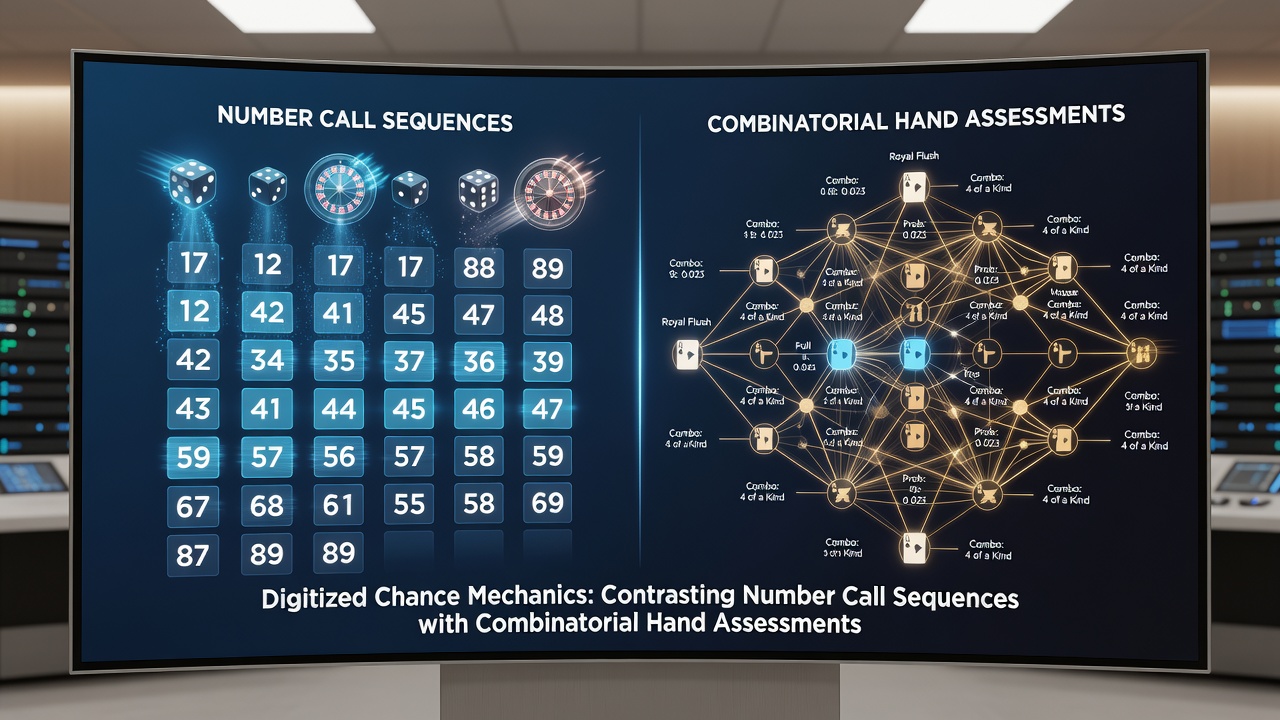
Digital platforms licensed for hybrid gaming integrate number call sequences drawn from randomized generators with combinatorial hand assessments that rank card sets according to fixed hierarchies, and observers note these mechanics operate under separate algorithmic protocols yet share the same regulatory oversight in many jurisdictions.
Number call sequences rely on pseudorandom number generators certified to produce uniform distributions across a defined range, typically 1 through 75 or 1 through 90 depending on the variant, while combinatorial evaluations in the same environment calculate probabilities from finite card decks that follow strict mathematical ordering such as pairs, straights, and flushes.
Sequence Generation Protocols in Digitized Bingo Variants
Researchers at institutions tracking online gaming describe how licensed platforms employ hardware random number generators or cryptographically secure algorithms to issue number calls one at a time, and each draw updates a player's grid without reference to prior hands or betting rounds. Data from regulatory filings shows that these sequences maintain independence across rounds, which means the probability of any specific number appearing remains constant regardless of elapsed calls, and hybrid systems log every output for audit trails required by oversight bodies.
Those who study platform architecture point out that bingo-style sequences feed directly into pattern completion mechanics, where players monitor rows, columns, or diagonals, and the process continues until a predetermined pattern emerges or a time limit expires. In October 2026 several North American operators updated their RNG certifications to align with revised technical standards issued by the Alcohol and Gaming Commission of Ontario, which now mandates continuous statistical testing of sequence uniformity.
Combinatorial Hand Assessments in Integrated Poker Modules
Combinatorial assessments within the same hybrid environments evaluate five-card or seven-card combinations against established rankings, and software performs exhaustive enumeration of possible outcomes from remaining decks to display real-time probabilities. Licensed platforms must ensure that shuffle algorithms reset deck states after each hand, preventing carryover effects that could influence subsequent assessments, and industry reports confirm that such resets occur within milliseconds.
Observers note that hand evaluation engines calculate equity using Monte Carlo simulations or exact combinatorial counts when table sizes remain small, and these calculations run independently of any concurrent number call sequences operating elsewhere on the platform. Figures from the Nevada Gaming Control Board reveal that approved poker modules undergo monthly randomness audits separate from bingo sequence verifications.
Integration Points and Regulatory Overlaps
Hybrid licensed platforms merge these systems through shared user interfaces that allow players to switch between sequence-based grids and hand-ranking tables, yet backend modules remain segregated to satisfy distinct certification pathways. According to a 2025 technical review published by the University of Nevada, Reno, operators that combine both mechanics must demonstrate that no cross-contamination occurs between random streams, and this requirement extends to logging formats used by compliance auditors.
What's notable is that European regulators, including those under the Malta Gaming Authority framework, apply equivalent separation rules while permitting promotional crossovers such as bonus triggers tied to either completed patterns or ranked hands. In October 2026 several Australian states began piloting unified reporting dashboards that consolidate sequence and combinatorial audit data for streamlined oversight.
Statistical Properties Across Both Systems
Statistical properties differ markedly because number sequences follow continuous uniform distributions over large ranges, whereas combinatorial outcomes cluster around discrete probabilities determined by deck composition and player count. Studies conducted by independent testing laboratories show that variance in sequence completion times exceeds variance in hand strength distributions, and platform designers adjust payout tables accordingly to maintain required return-to-player percentages across the combined offering.
Those who've examined audit logs observe that hybrid environments track millions of draws and hands monthly, with anomaly detection algorithms flagging deviations beyond established confidence intervals, and regulators receive aggregated reports rather than raw sequences to protect operational integrity.
Conclusion
Licensed hybrid platforms continue to refine the technical boundaries between number call sequences and combinatorial hand assessments, and ongoing certification updates in multiple jurisdictions ensure both systems maintain independent randomness standards while coexisting within single player experiences.